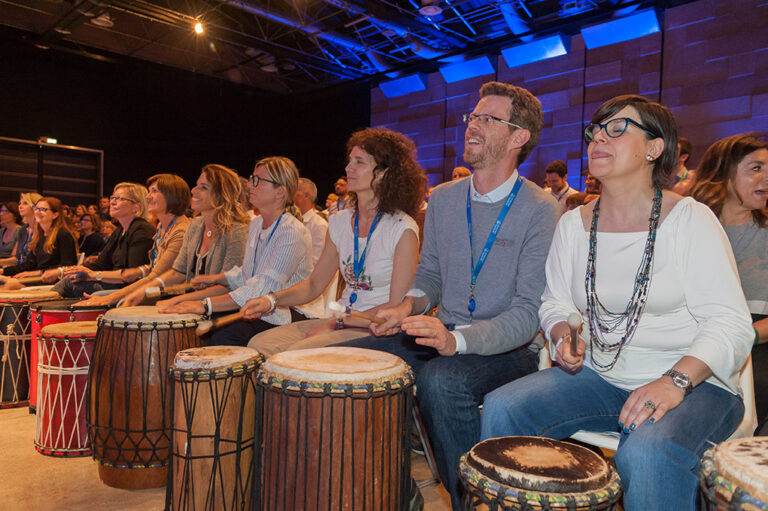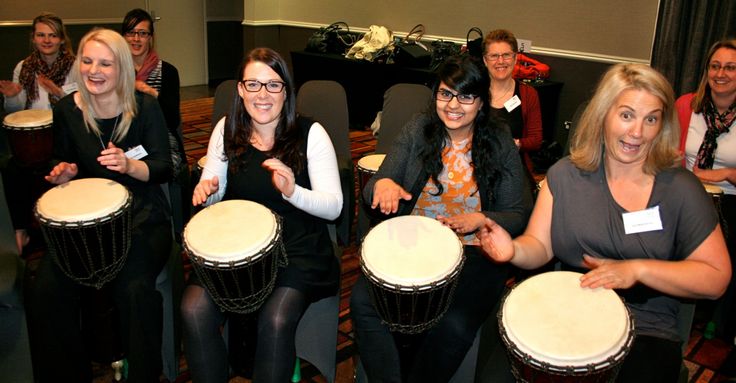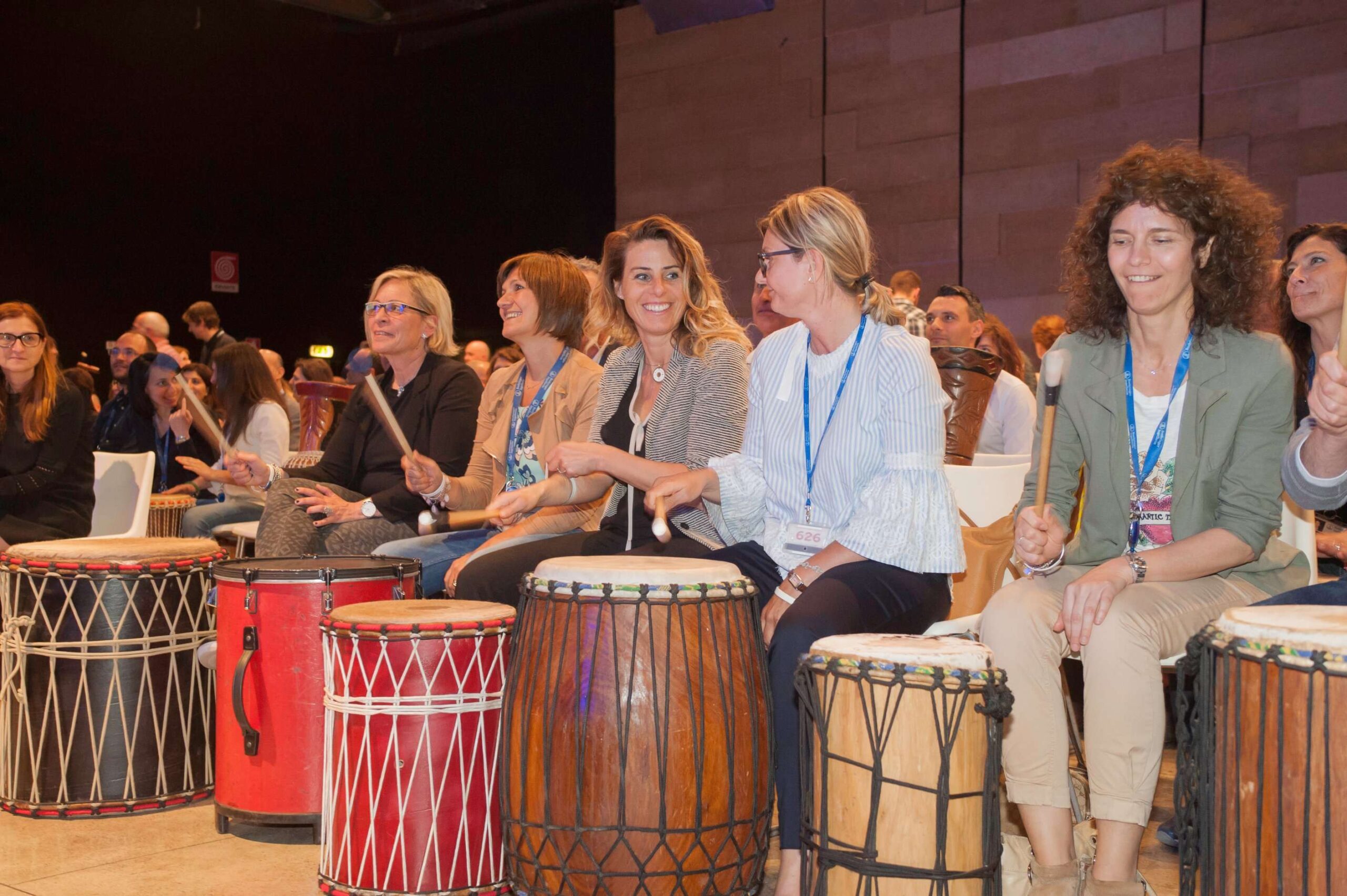
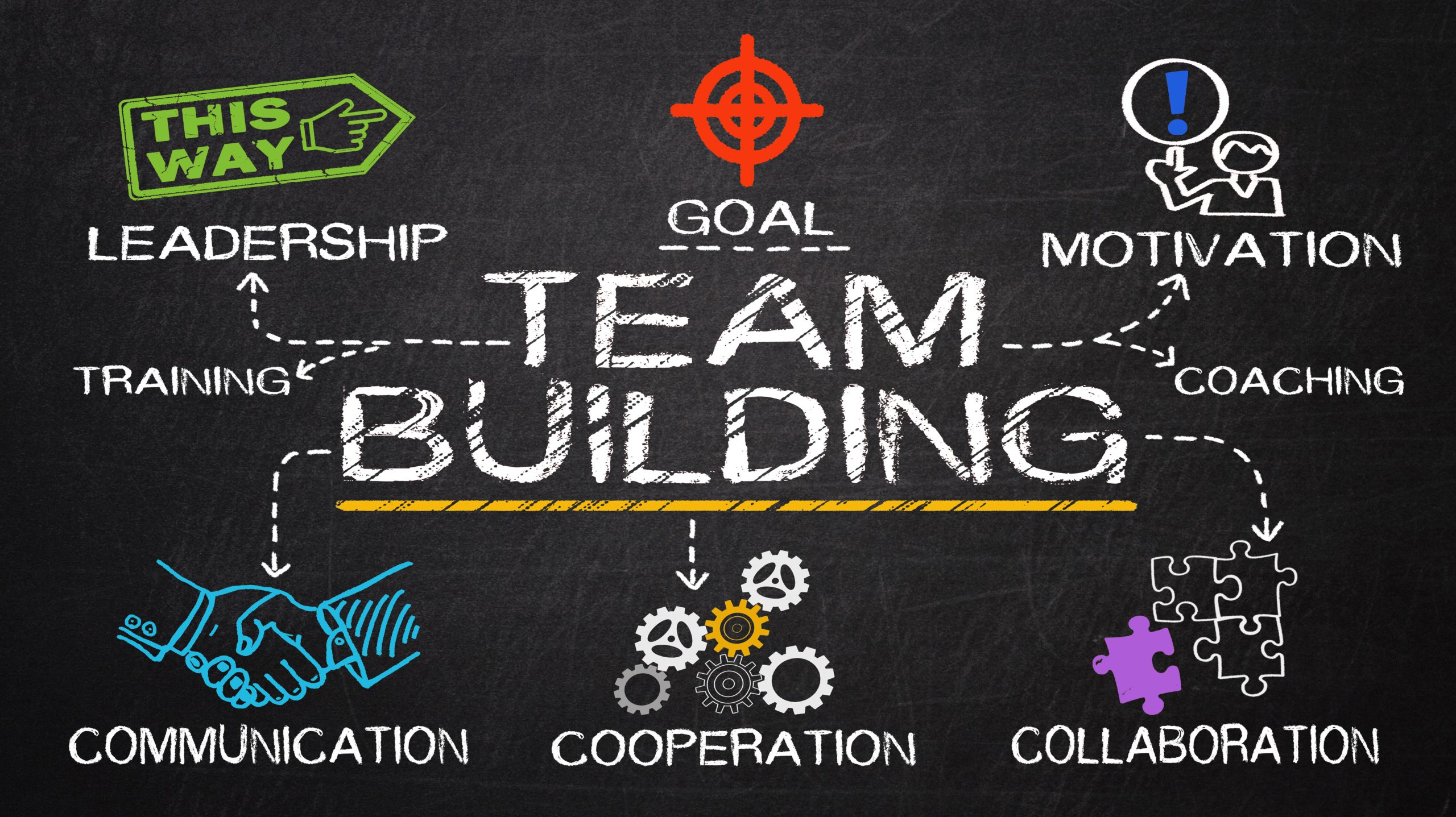
Are you wondering what is a team building?
Do you need a team building activity for your corporate event but you are unable to find your way due to a large offer?
You are in the right place, in this article you will find synthetic answers to these questions.
In this article...
What is a team building?
At international level, the term team building (or teambuilding) indicates specific training methodologies developed with the aim of improving the functioning of a group of people.
Born in the United States, teambuilding was initially used successfully with children, but later found the ideal field of application in corporations with task-oriented work teams.
Shortly, the aim of teambuilding is to develop individual and relational skills which allow people to work more effectively in teams and, consequently, improve their results, performances and well-being.
These activities can be experiential, motivational or purely playful.
Teambuilding activities are growing in popularity but there is often a great confusion around them and, sometimes, ignorance as well.
Team building objdectives
Teambuilding can have many achievable goals which can be designed according to the needs and peculiarities of each business case.
Below is a short list of the objectives which are most requested:
- Making a deeper relationship in a non-invasive way between people.
- Creating relationships and increasing cooperation.
- Develpoing mutual listening and communication skills.
- Facilitating empathy and mutual trust between colleagues.
- Motivating the team, creating cohesion and integration.
- Developing leadership skills, educating to delegate and work by objectives.
- Stimulating creativity.
- Conveying vision, mission and corporate values.
- Bringing together and integrating different company departments.
Team building for incentive events
Team building activities have two main areas of application which can be achieved individually or together: incentive and training.
Both have the characteristic of having an experiential approach in which the participant is always the main actor.
This happens thanks to the strong emotions which are generated during the activity, the multisensory involvement and the atmosphere of interaction and exchange with others.
Teambuilding in incentive events has the main objective of conveying a strong emotion of union and integration to the team through the achievement of a final result, which could have seemed difficult or impossible at the beginning of the team building.
During or after the end of the activity, communication windows can be opened in order to transmit the training metaphors agreed previously with the customer.
However, metaphors are only developed in the form of pills, without a final debriefing consisting of the logical and emotional collection of the experience.
Thing which happens instead in a training, using discussion and mutual feedback.
Experiential training and trainer's role
Experiential training methodologies have the aim of training people on aspects related to the field of behavior, with the advantage of achieving higher efficacy indices than those achievable with traditional classroom trainings.
In fact, let’s ask ourselves for a moment: what has changed us most in our life?
Was it the words of our teachers, the books we studied or read, the things that were said to us?
Or, perhaps, in reality were the experiences we lived firsthand that changed us the most?
Experience is the main tool for human learning.
It involves all our five senses, it is usually accompanied by strong emotions and it often makes us to interact with other people.
That’s why experiencing something firsthand rather than being told about is much more complete.
The experiential approach increases the possibility to generate learnings which will remain in our memory and will actually change our behaviors and actions.
This happens through a debriefing process that we can briefly summarize with “learning through reflection on doing.”
The expert in experiential training is a professional who, starting from the client’s objectives, is able to “design experiences” through the understanding of which type of experiences are more suitable in order to achieve the corporate objectives.
The experiential trainer or team builder is therefore the professional who accompanies the team in the following four basic steps:
- Analysis of purposes.
- Designing the activity.
- Process management
- Transfering from the experience to the learning.
At this point, confusion may arise in the large offer of team building marketplace, especially for those who are not experts but have the task of organizing an activity for their team or company.
For example, we can find incentive operators who offer teambuilding activities as if they were simple animation activities, or classroom trainers who improvise experiential interventions.
So we can come across go-kart races or corporate Olympics passed off as teambuilding, or training agencies which sell theoretical teambuilding courses not understanding that it is essential to experience teambuilding firsthand.
Team building is not this, or at least it can be much more.
Team building: different types and duration
Teambuilding activities are more and more a priority for all companies since the leaders understand well how teamwork is essential to improve the corporate performances.
That’s why teambuilding events continue to increase in Europe.
We can distinguish the different teambuilding types in the following way:
Team building in an experiential training
Teambuilding activities of at least 3 hours which usually involve from 5 to 25 participants with the aim to train them to improve their teamworking skills.
In this case, the activity is mainly a tool to bring out the metaphors that will be addressed and shared to the participants in the final de-briefing.
Motivational team building
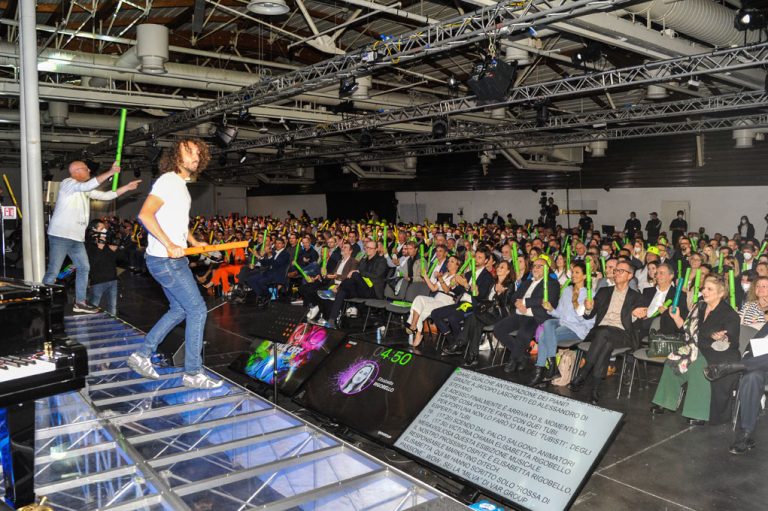
Teambuilding activities suitable for large audiences as well, which can even last 1h / 1h 30min during a corporate meeting or convention.
They are motivational, energetic, joyful and the main aim is to transmit simple messages related to the corporate vision or mission.
Playful team building
These are fast teambuilding activities which take place in most cases during a big convention, corporate dinner, roadshow or just in a quick corporate meeting.
In addition to employees, also agents, business partners, and customers are often invited.
The goal is simply to create team spirit thanks to an amazing experience for people who just meet occasionally to each other.
They often take the structure of ice-breakers or energizers with a maximum duration of 30 minutes.
Social team building
In recent years, the desire to team up has become more and more related to the willingness to activate social responsibility initiatives, doing something positive for the community.
It is an opportunity for the employees to make teamwork by supporting people with handicaps for instance, recovery communities, sick or poor people, or any other kind of social association.
Team building online
Due to Covid-19, online team building activities are developing significantly.
Virtual and online activities already became a new field in the team building marketplace.
Although they are obviously less engaging than live team building, they have the advantage of being able to join and involve transversal teams from all over the world in a very simple way.
The price is very convenient and they are a great tool to develop mutual listening and better communication in the new age of smart working.
Team building effects
As we mentioned in this article, it is scientifically proven that a real teambuilding activity stimulates good mood and better team functioning.
Here just some of the most important effects:
- Development of communication skills.
- Greater mutual listening and trust.
- Team integration.
- Improvement of problem solving skills.
- Ability to cope with the ongoing change of marketplace conditions.
- Better stress management.
- Greater time and deadline management.
- Ability to face the personal and business crisis.
- Team spirit.
When to organize a team building
A teambuilding activity can be useful on multiple business occasions such as:
- During a convention, congress or launch of a new product or brand.
- In a delicate period for the company: a merger or a moment of crisis.
- As a celebratory moment in order to have the high energy peak in the meeting.
- During a corporate family day, as a recreational activity suitable for all ages.
- During a party such as Christmas, or on another particular company anniversary.
- As a part of an incentive trip.
Team building activities
As previously mentioned, team building is a vast market offering countless activities, ranging from training-focused to incentive options.
For this reason, it would be overly lengthy to describe every single type here; however, you can find the most popular broad categories below
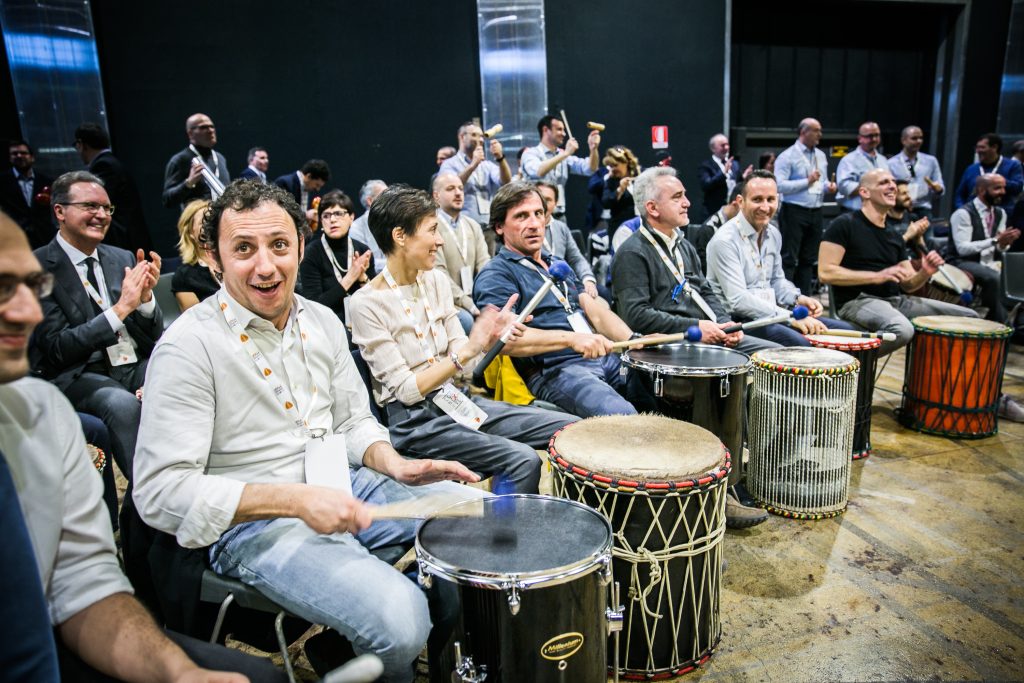
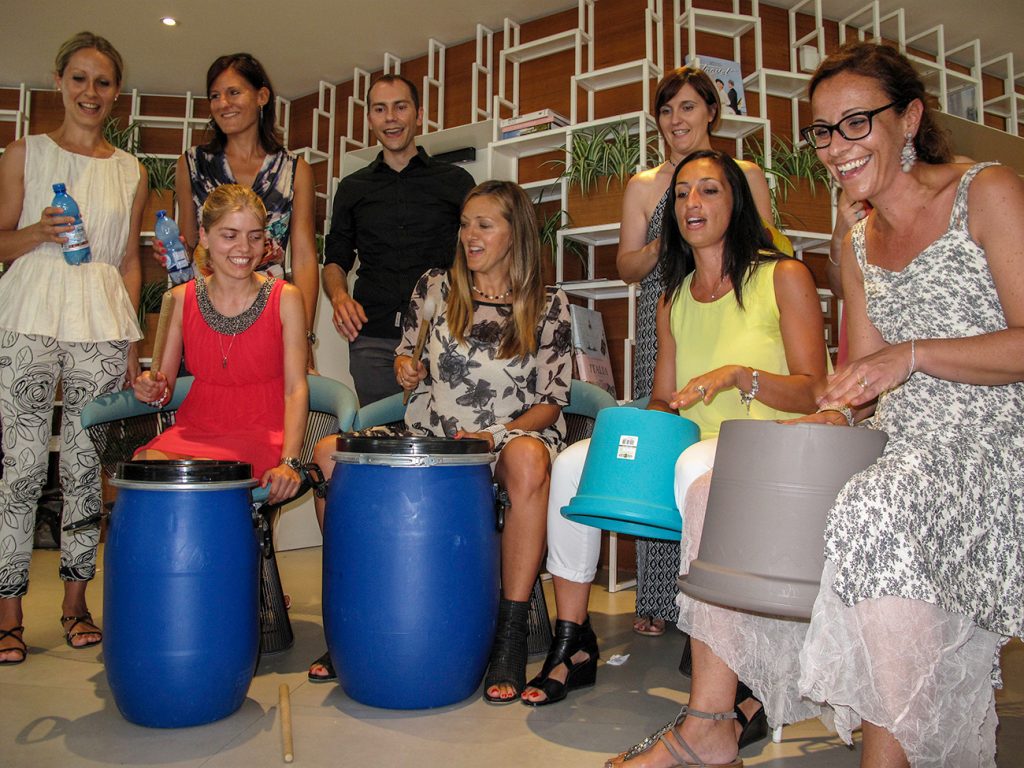
- Art: music, theater, cinema, painting.
- Outdoor: orienteering, survival, nature.
- Cooking: cooking, cocktail challenge.
- Sport: sales, engines, cartoon boat.
- Urban game: treasury hunt, escape room.
- Creativity: lego, photograph.
We at OneBeat, as the european leading agency regarding Music Team Building.
You can discover our innovative activities, chosen by over 1,000 companies, by watching the following presentation video.
Testimonials
Further reading

Team Building: 10 Things to Know Before Choosing an Activity
Team Building or Experiential Training? Which activity? Here the map of the 10 things to know before choosing a team building activity.
Team Building: History and Origins
Discover the history and origins of team building.
The story of a discovery made by chance as an incidental byproduct of other experiments.